Living the Forest Lab | Reallabor Wald
Sara Reichert
s.reichert@tu-berlin.deAthena Grandis
athena.grandis@tu-berlin.deA workshop to explore situated ways of mapping spaces.
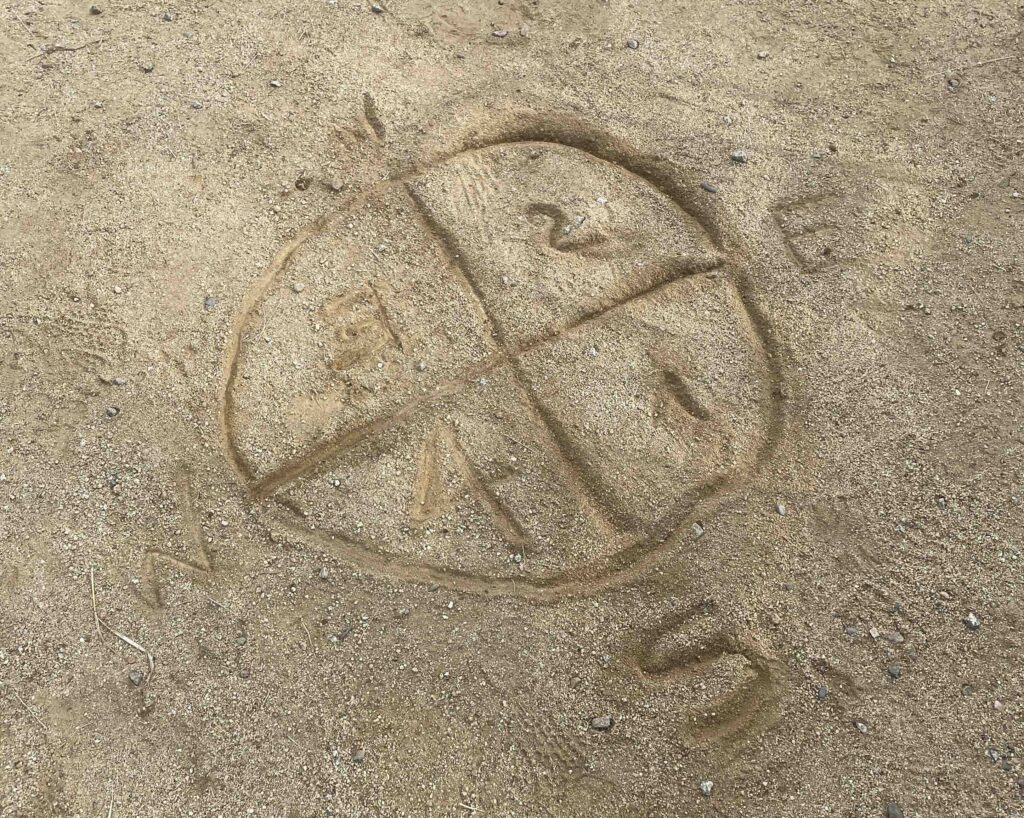
During our excursion to Berda, Spain, we dedicated one half day to exploring and documenting the environment around us through a collaborative mapping exercise. The goal was to discover our surroundings by creating one collective map that would capture both the physical terrain and our individual experiences of it.
We divided the group into four subgroups, each responsible for exploring one cardinal direction from our starting point. Armed with notebooks, cameras, and bags for collecting materials, each team set out for an hour of discovery. The task was open-ended: observe, document, photograph, and gather whatever caught their attention along the way.
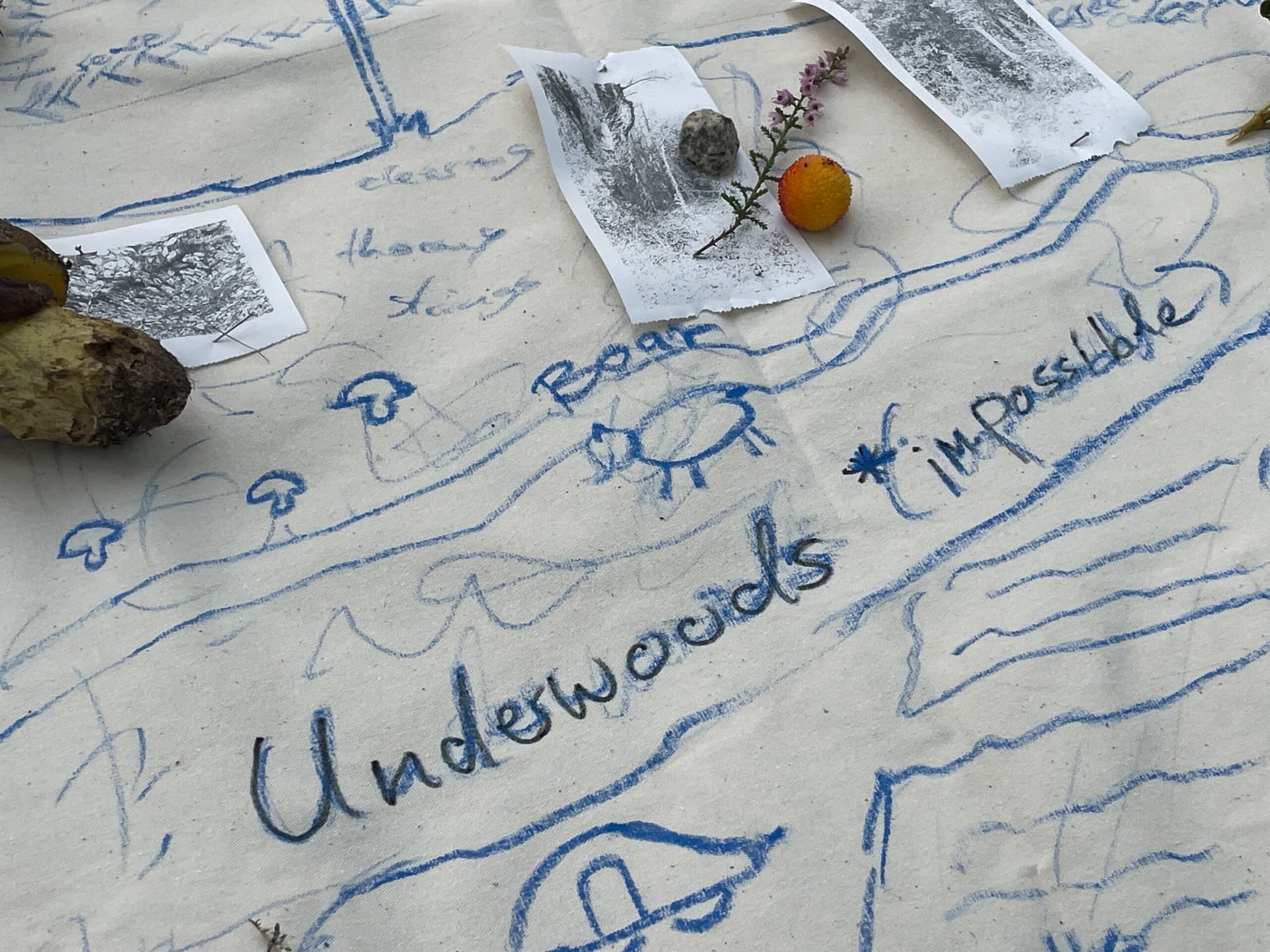
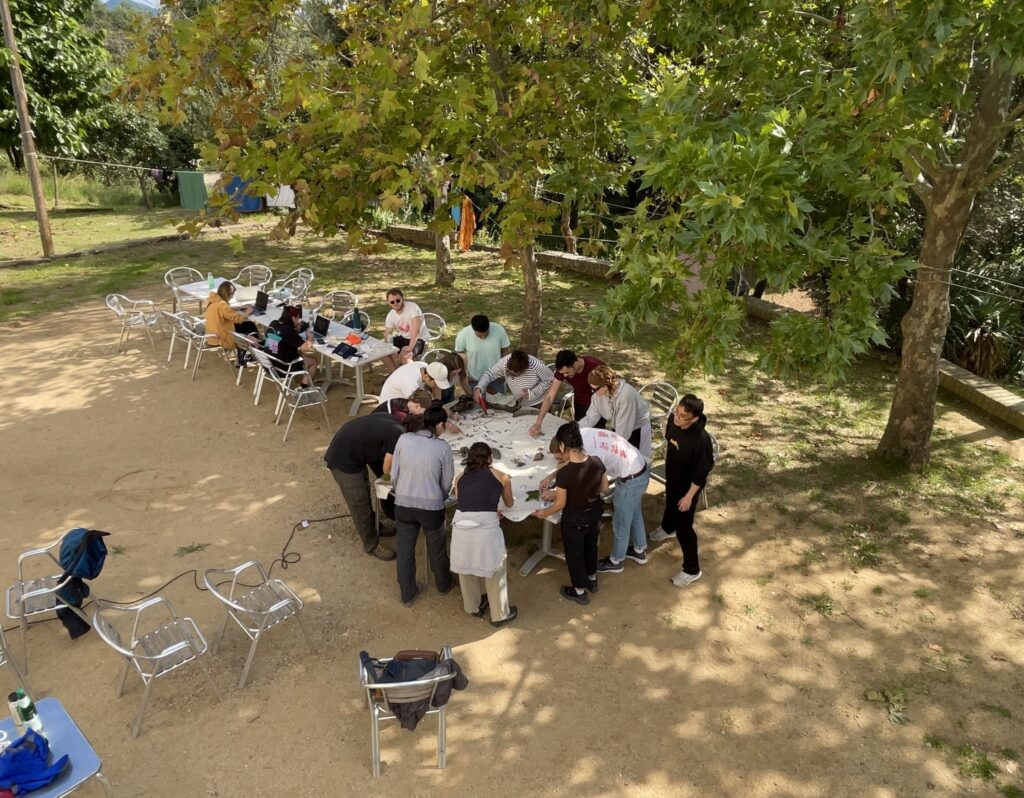
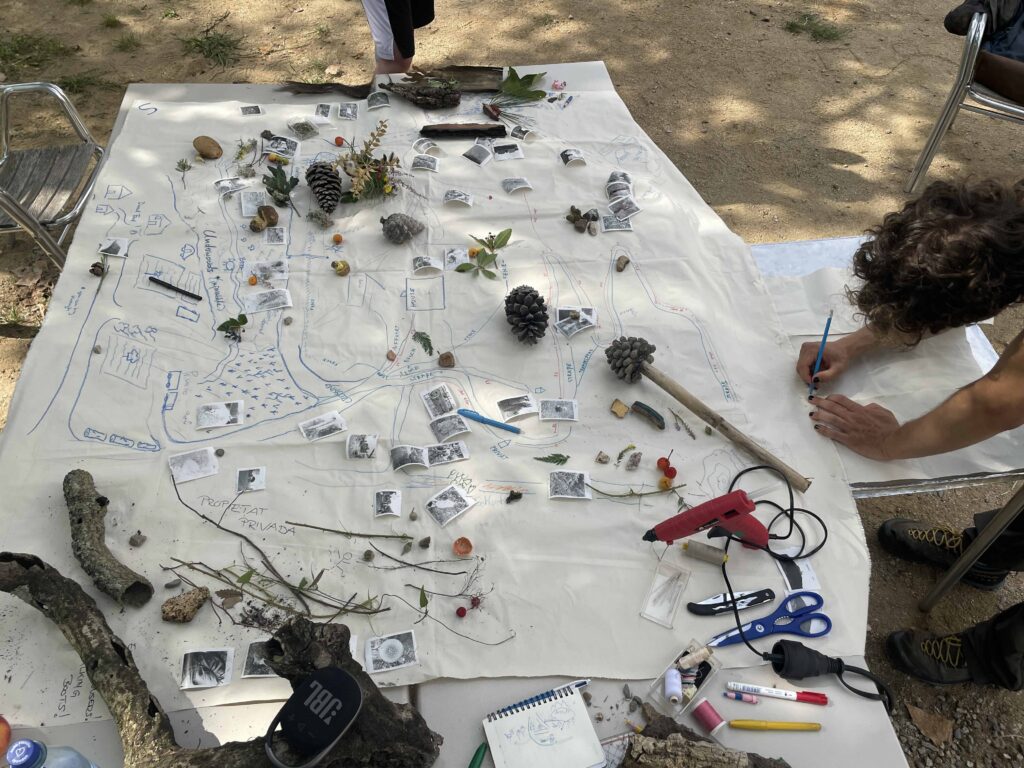
After the exploration phase, we reconvened to create the map. On a large piece of fabric, we marked only the central starting point. From there, each person drew their unique route, tracing the path they had taken during their exploration. The found materials—leaves, stones, twigs, and other objects—were attached directly to the map at the locations where they had been discovered. We printed the photographs using a thermal receipt printer and pinned them onto the fabric, creating a visual diary of our journey.
What emerged was far more than a geographical representation. The maps became deeply personal artifacts, filled with anecdotes and stories. Each participant had explored the environment in their own way: one person meticulously photographed every piece of litter they encountered along their route, while another counted each step they took, turning their walk into a measured meditation.
The result was a rich, layered document—part map, part artwork, part collective memory—that revealed how differently we each perceive and interact with the same landscape.
Co-mapping and Counter-mapping as Feminist Cartographic Practices
Feminist counter-mapping and co-mapping represent critical interventions into traditional cartographic practices by challenging patriarchal knowledge systems and centering marginalized, affective, and embodied experiences. Counter-mapping, as a decolonial and intersectional practice, seeks to make invisible data visible—documenting gender-based violence, and revealing how systems of power structured by race, class, and sexuality shape spatial realities (Risler and Ares, 2018). This approach reclaims space by challenging the objective, top-down methodologies of traditional Geographic Information Systems (GIS) that often reinforce existing inequalities by ignoring the specific needs and experiences.
Co-mapping, by contrast, emphasizes participatory processes where communities collaboratively produce spatial knowledge, transforming mapping from an extractive exercise into a collective practice of place-making and care. Both practices align with speculative-feminist frameworks that reimagine mapping technologies—from satellites to smartphones—not as instruments of surveillance or the “god trick” perspective (Haraway, 1988), but as potentially subversive prostheses that inscribe local context, situated knowledge, and imaginative propositions into planetary images (Gabrys et al., 2016). These feminist cartographic methodologies thus challenge the ubiquity of platforms like Google Maps, which often fail to represent informal settlements, or the economic, social, and ecological layers of urban life, revealing how dominant mapping infrastructures systematically exclude spaces and experiences that escape traditional Western urbanization patterns. By integrating affective cartographies—documenting everyday routes, emotional geographies, and embodied navigations through space—co-mapping and counter-mapping transform spatial representation from a technical exercise into a political and ethical practice that honors the complexity of lived experience.
References
Risler, Julia, & Ares, Pablo. (2018). Manual of Collective Mapping. In: kollektiv orangotango (Eds.), This Is Not an Atlas (183-204). Bielefeld: transcript Verlag. https://doi.org/10.14361/9783839445198-024
Haraway, Donna. (1988) Situated Knowledges: The Science Question in Feminism and the Privilege of Partial Perspective. Feminist Studies 14, no. 3: 575–99. https://doi.org/10.2307/3178066.
Gabrys, Jennifer; Pritchard, Helen and Barratt, Benjamin (2016) Just Good Enough Data: Figuring Data Citizenships through Air Pollution Sensing and Data Stories. Big Data & Society, 3 (2). pp. 1-14. ISSN 2053-9517
Graduated from the Technical University of Berlin and University of Artis in Design & Computation, a transdisciplinary study program. She holds a bachelor’s degree in Visual Communication from the Berlin University of the Arts and the Bezalel Academy of Arts and Design in Jerusalem. Her interests include feminist perspectives on digitalisation, queering technology and human-machine interaction and relationships. Her practical work moves between media such as installation, print, video, wearables, illustration and prototyping.